
Why Subdivide ?
Do you properly understand ALL of the potential benefits of splitting your residential block?
It has become incresingly common to hear family and friends discussing the subject of subdividing or developing a block of land that they own. Even as close as 10 years ago, it was only those of us with experience or the wealthy who would even consider the process. With the disparity between housing supply and demand getting wider it seems that 'developrs' are oozing out of every crevice imaginable, enticing you to subdivide and/or develop with them in order to become 'financially free'
The biggest concern as always with a perceived real estate boom, is that sleek salesmen pop up and offer all sorts of financial sparkles to the unwary landowners. It is a process that can be smooth and simple for the experienced, because we already have a solution for every problem. It can also be a process that becomes a major stressor and money pit if the early decisions are not made correctly, or problems anticipated and planned for.
Write a goals list - What do you want to get out of the deal ?
when we ask our clients this question they ALWAYS say - money. But what do you want the money for? To pay out your existing loans? to build a new maintenance free home for your retirement? to use for living expenses? to splurge on a trip of a lifetime? set up younger family members? create a legacy? Only by getting to the bottom of the why? will we be truly able to help our clients to acheive the maximum result possible.
We have often been able to offer solutions that the clients had never thought of, nor previously been offered by others. This is especially important when it comes to property that has been inherited, clients are already dealing with the trauma of clearing out their relatives home, and really they just want the whole thing over with asap. These clients are the most vulnerable to greedy investors, whose purpose is certainly not the best interests of the new propertyowners.
By spending time listening to our clients and learning about their situation we can offer a considered and appropriate solution that will fulfill the needs of the client, however many are involved.
What are the common options for a large residential block?
Lets consider a family who have inherited a small brick house on a larger block of 1200 sqm in an older suburb 15 km from the city, where the local council have rezoned from R20 to R60. Considered an 'infill area' this council are activley promoting subdivisions and new building in this area, the family have several options for this property; they can-
* Sell the house as is with 'development potential' - this will acheive the fastest sale but the lowest possible price.
* Submit a development application and sell with DA approval, having done no work - this will clear a higher price and incur minimal costs.
* Fulfill the requirements of the DA and sell the newly assigned blocks ready to build on - this will acheive high returns and moderate costs.
* Build new homes on each of the newly assigned blocks +/- renovate the existing house and then sell - this will acheive the maximum possible profit, but also cost the most in outlay, take the most time and have the potential to
encounter issues.
The zoning codes throughout Australia are labelled differently (rather like different languages) but they all follow the same federal rules. In WA R20 means its acceptable to build 20 houses for every hectare of land. This gives an average block size of 450m sq with a minimum of 350m sq.These are generally the smallest of the individual home sites. R60 allows 60 residences per hectare and is considered medium density, the average land size would be 160 m sq with the minimum being 120m sq. These are considered townhouses and although individual blocks are seperatly titles they tend to be part of a complex with a single main street address and homes identified by unit number.
It would be possible to subdivide this block into a maximum of 9 if the shape and access are all perfect. Most likely though it would be between 6 and 8. However, if the existing house is in good condition there is no need to destroy it for no real reason and this is where many 'developers' or landowners fall over, they do not do a full analysis of the figures and often cause unnecessary waste of time and money. The option of keeping a good house is not even considered by a 'developer' who is primarily a builder, and whose aim is actually to get as many of their products on your land as they possibly can.
The benefits of keeping the original house are that it can create an income during the application and land works phases, this will help towards costs if families are really struggling.
Families who find themselves in posession of these larger blocks often become overwhelmed with the possibilites and sometimes the large numbers involved during the discussions about options, and this is the single reason they often choose the easy option of quick sale. Having been through this process personally I can vouch for the benefits of having someone advocate for the long term outlook because it is a guarantee that 1 or 2 years down the track, once the block has been built on there is always a level of regret. Many wistful jokes are made about being able to retire early if families had been in a position to create that particular finished product.
How can ordinary families benefit more from this massive exchange of wealth
As previously discussed, the most benefit is acheived from completing a proposed subdivision and building new homes on the site. Of course, this is also the most expensive and, if not structured properly, can put the families at most financial risk. However , when correctly structured, there is zero risk to the families, the only downside is that they may need to wait until final settlement to see any of the profits.
The main way to reduce risk is to make presales, because this involves contracts it becomes much easier to get finance for whoever is doing the construction. For this to occur, someone needs access to a list of approved buyers or investment companies who are eager to gobble up this sort of property in the blink of an eye. Working with people in the industry who have been around a long time and who have created good relationships with buyers, bankers etc is paramount to smooth profits.
The biggest buyers of (income producing) property at the moment are superannuation companies and banks. In part due to stock market instability and banking profits being restrianed by legislation, this has made the selling process easier but created more competition for buyers.
If you would like a property analysis for your property or would like to get some more information about anything mentioned do not hesitate to give us a call on 08 9304 4741 or email client@thewomandeveloper.com

ABOUT
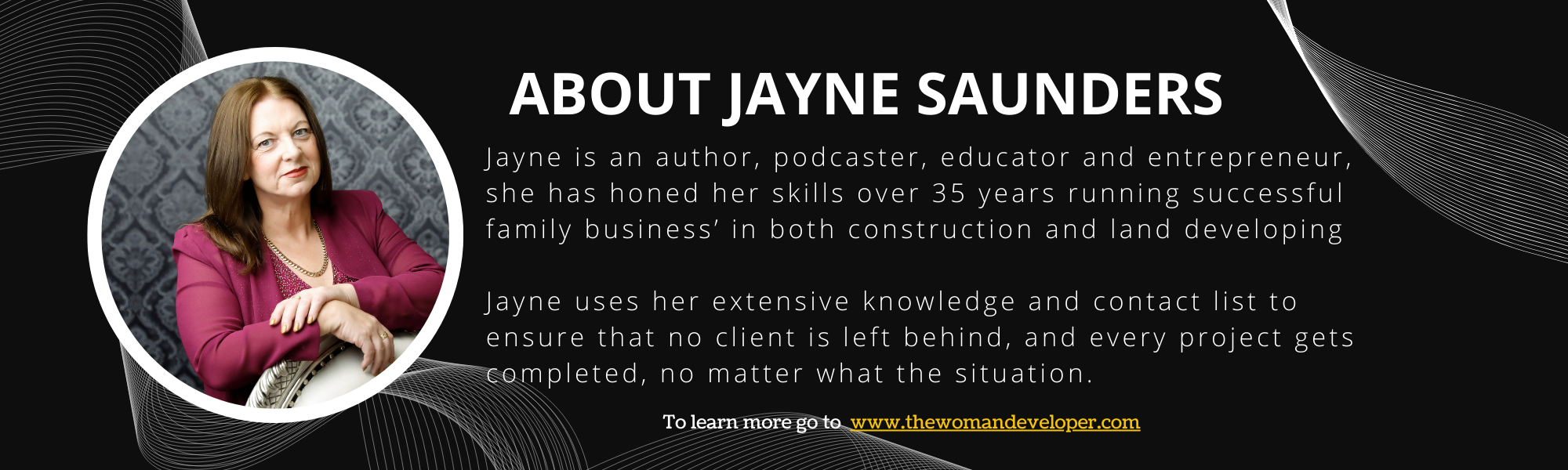
With 30+ years experience, Jayne is an industry leader with an extensive knowledge base, and is the face of this family business.
Created with © systeme.io
Follow us on socials


